Play Anti-Reversi
The upside-down Reversi where the fewest discs wins - lose to win.How to Play Anti-Reversi
In a nutshell: The upside-down Reversi where the fewest discs wins - lose to win. You play on an 8 × 8 board (64 squares), it's rated mind-bending, and it's everything reversed - the player with the fewest discs wins.
Anti-Reversi, also called Reversed or Misere Reversi, keeps every rule of the classic game but flips the goal: when the board fills up, the player with the fewest discs wins. That one change turns your instincts inside out. Suddenly flipping lots of discs is bad, corners can be poison, and the greedy-looking move is often the smart one. You still have to make legal flanking moves - you cannot simply refuse to flip - so the challenge is steering the flow of the game so that your opponent is forced to accumulate discs while you stay lean. It is a fiendish, counter-intuitive puzzle that will scramble the brain of anyone who has drilled normal Reversi strategy, and a brilliant way to test whether you truly understand why the standard moves work - because here, most of them are exactly wrong.
Anti-Reversi at a glance
| Goal | End the game with FEWER discs of your colour than your opponent. The majority loses; the minority wins. |
|---|---|
| Board | 8 × 8 - 64 squares |
| Players | 1 player vs the computer, or 2 players online |
| Difficulty | Mind-bending |
| How it plays | Everything reversed - the player with the fewest discs wins |
| Computer levels | Easy, Medium, Hard |
| Category | Rule Twists |
Step by step
Goal
End the game with FEWER discs of your colour than your opponent. The majority loses; the minority wins.
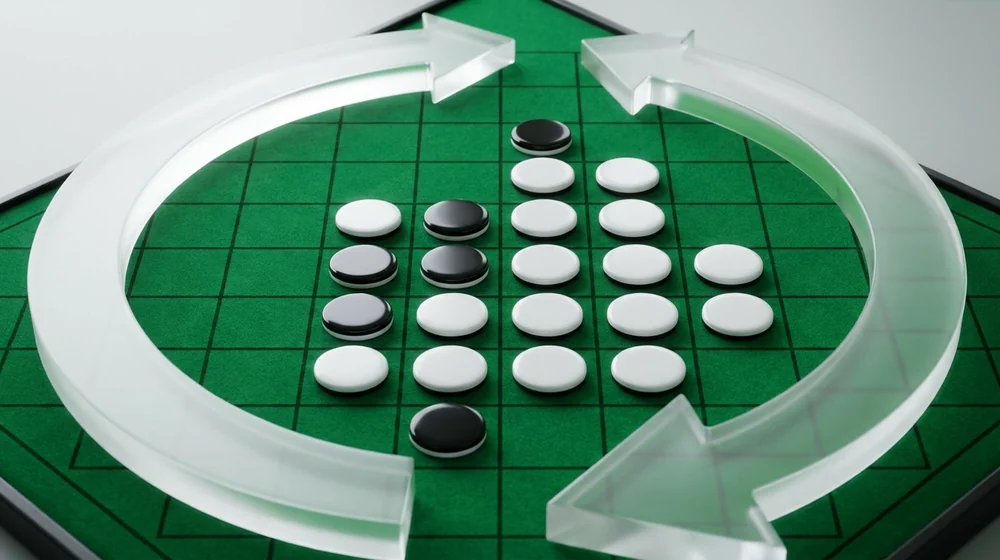
Same moves, opposite aim
All the normal rules apply: you must place a disc that flanks and flips at least one enemy line. You cannot pass by choice.
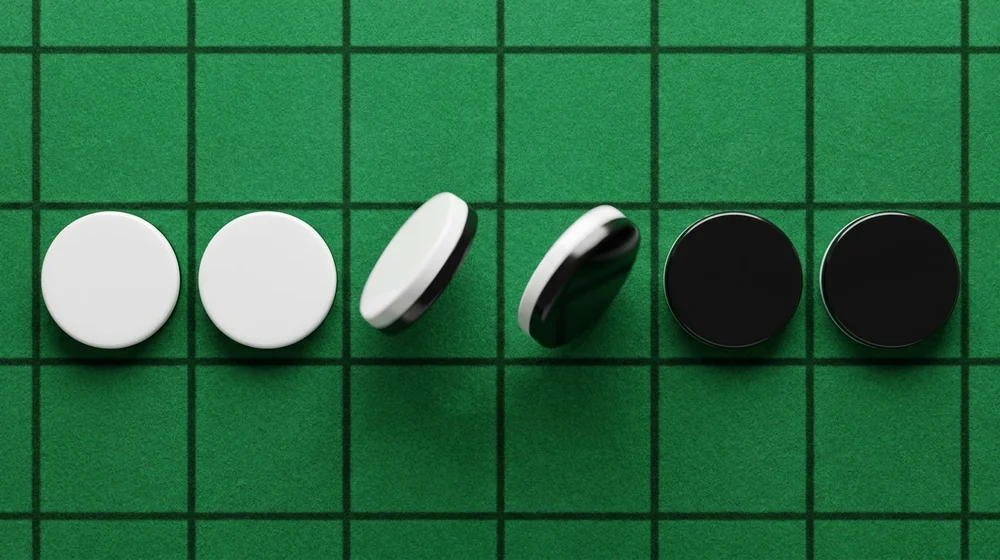
Flipping still happens
Every move still flips the trapped enemy discs to your colour - which is now usually bad news, since you want to own as few as possible.
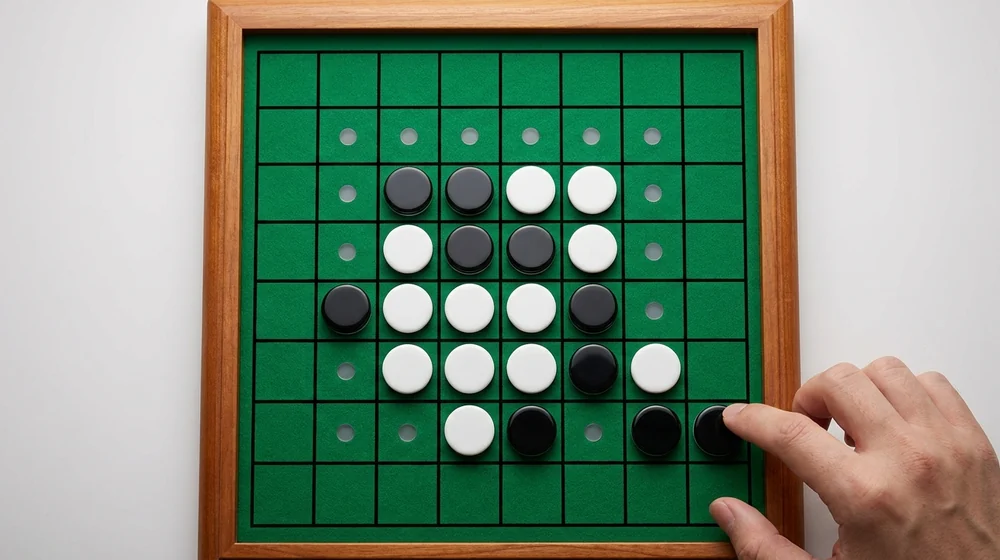
Legal moves only
As in normal Reversi, you may only play where something flips, and your turn is skipped if you have no legal move.
Winning
When the board is full or nobody can move, count discs. The colour with fewer discs wins; a 32-32 split is a draw.
History of Anti-Reversi
Misere - or "reverse" - variants exist for many classic games, from checkers to tic-tac-toe, and they follow a simple, mischievous idea: keep the rules but invert the goal so that losing becomes winning. Anti-Reversi is the misere form of Reversi, and it has been played informally for about as long as the standard game.
Its appeal is largely psychological. Because Reversi has such well-known strategic maxims - take the corners, limit mobility, hold few discs mid-game - inverting the goal creates a game where applying those maxims blindly leads straight to defeat. That makes Anti-Reversi a favourite challenge among experienced players who enjoy having their instincts turned against them.
While it has no formal championship of its own, Anti-Reversi remains a beloved variant in Reversi and Othello circles, valued as both a playful diversion and a genuine test of whether a player understands the underlying logic of the standard game rather than merely memorising its rules of thumb.
How to Win Anti-Reversi: Strategy
💡 Top tip: Think in reverse: corners, normally prized, are often traps here because a stable corner disc you can never flip away pads your count.
Winning tips, in order of importance
- Try to force your opponent to do the flipping - manoeuvre so their moves pile discs onto their own colour while yours stay few.
- Avoid moves that flip long lines toward you; the small, stingy flip is usually the good one in Anti-Reversi.
- Mobility still matters, but now you often want to give your opponent moves that force them to gain discs, not deny them moves.
- Watch parity closely - being forced to make the last flip in a region, dumping a pile of discs onto your colour, frequently loses the game.
- Do not blindly apply normal Reversi corner strategy; a corner is only good here if it lets you shed discs or force your opponent to gain them.
- Set traps where every legal reply your opponent has flips discs onto their own side, then keep quietly staying small.
Advanced tactics for Anti-Reversi
- Re-evaluate every square by its cost, not its value: a permanently stable disc is now a permanent liability, so the usual 'good' squares become the ones to avoid.
- Aim to reach positions where your opponent's only legal moves flip discs onto their own colour, effectively forcing them to win the count and lose the game.
- Master reverse parity - engineer the move order so your opponent is the one compelled to make the big fattening flips at the end of each region.
- Keep your options for small flips open; being able to choose the stingiest legal move on each turn is the core skill of the misere game.
- Treat corners as conditional: only take one when it lets you offload discs elsewhere or hands your opponent a discs-gaining obligation.
- Deny yourself tempting mid-game flips; the line that flips fewest discs now is almost always better than the one that flips many.
- Study your losses to see which forced flip ballooned your count, then look for the earlier move that could have handed that obligation to your opponent instead.
Common Anti-Reversi mistakes to avoid
- Grabbing corners out of habit - a corner disc can never be flipped, so it permanently pads the count you are trying to keep low.
- Taking the biggest flip - flipping a long line onto your own colour is exactly what loses the misere game, so choose the stingiest move.
- Playing to deny your opponent moves - here you often want to force them to gain discs, not to limit them.
- Ignoring reverse parity - being the one forced to make the last fattening flip in a region is how most Anti-Reversi games are lost.
Anti-Reversi Variations
Standard Reversi
The normal game, where the most discs wins - the exact opposite goal, and the best reference point for understanding what Anti-Reversi inverts.
Anti-Othello
The same misere goal played from Othello's fixed diagonal opening, popular among tournament players looking for a twist.
Small-board misere
Anti-Reversi on 4x4 or 6x6 becomes a tight, fully calculable puzzle where reverse parity is everything.
Misere in other games
The same 'lose to win' idea powers reverse checkers, misere tic-tac-toe and more, all sharing Anti-Reversi's inverted logic.
Mixed-goal matches
Some players alternate normal and anti games in a match, rewarding whoever can switch strategic gears the fastest.
Anti-Reversi FAQ
How is Anti-Reversi different from normal Reversi?
The rules of play are exactly the same - you flank and flip enemy discs - but the winning condition is reversed. Instead of the most discs winning, the fewest discs wins, which inverts almost every strategic principle of the standard game.
Do I still have to flip discs?
Yes. You cannot choose to pass or to make a non-flipping move. On every turn where you have a legal move, you must play one that flips at least one enemy disc, just like normal Reversi. The skill is in choosing which of your forced flips hurts you least.
Are corners bad in Anti-Reversi?
Often, yes. A corner disc can never be flipped, so it permanently adds to your count - and in Anti-Reversi a high count is what you are trying to avoid. Corners are only good when taking one lets you shed discs elsewhere or forces your opponent to gain more.
Is Anti-Reversi harder than the normal game?
Most players find it harder at first because years of Reversi instinct now point the wrong way. Once you retrain your thinking around forcing your opponent to accumulate discs, it becomes a deep and rewarding puzzle in its own right.
Can Anti-Reversi end in a draw?
Yes - if both colours finish with 32 discs, the game is a tie, exactly as in the standard version. The reversed goal does not change how ties are scored.
What is the best way to start learning Anti-Reversi?
Play a few games simply trying to keep your own disc count low and noticing which moves force your opponent to gain discs. Resist your normal corner-grabbing habits and watch how the endgame parity decides who is stuck making the fattening final flips.
Why is it also called Misere Reversi?
Misere is the general term in games for a version where the normal goal is inverted and you try to lose by the usual measure. Anti-Reversi is the misere form of Reversi, so 'Misere Reversi' and 'Reversed Reversi' refer to the same upside-down game.
Does the first player still move first?
Yes. Dark still moves first; only the scoring is reversed. Whether moving first helps or hurts in the misere game is subtle and often the opposite of the standard game.
Anti-Reversi guides & strategy
- What is Anti-Reversi (Misere Reversi)?
- How to win at Reversi: the principles you'll invert
- Browse the full Reversi FAQ
Still have a question about Anti-Reversi? Browse the full Reversi FAQ, look up a term like flank or mobility in the Reversi glossary, or compare Anti-Reversi with the other variants in the rules for every Reversi game.
Last updated .