Play Reversi Against the Computer
The classic disc-flipping duel against the computer or a friend - plus the one thing most Reversi sites lack: real-time online multiplayer. No download, no signup.Reversi.now is a free online Reversi site with seven variants - classic Reversi, Othello, Anti-Reversi and more - a shared daily challenge, and real-time multiplayer that lets you and a friend play head-to-head on the same board. There's nothing to download and no account required: just pick a difficulty and start playing below.
Other games worth playing
How to Play Reversi
In a nutshell: The classic disc-flipping duel - outflank your opponent and rule the board. You play on an 8 × 8 board (64 squares), it's rated easy to learn, a lifetime to master, and it's an even fight - the four corners decide most games.
Reversi is the classic two-player game of flanking and flipping. You and your opponent take turns dropping discs onto an 8x8 board; every enemy disc you trap in a straight line between two of yours flips to your colour. The twist that keeps Reversi endlessly fresh is that the lead swings wildly - a board that looks lost can flip to a landslide in two or three moves, so the player with the most discs in the middlegame is often the one about to lose. This version uses the free opening: for the first four moves each player places a disc on any empty centre square, so no two games start the same way. Play the dark discs against a computer that ranges from a gentle beginner to a corner-hungry expert, or challenge a friend online.
Reversi at a glance
| Goal | Finish the game with more discs of your colour than your opponent. When the board fills up (or neither side can move), the majority wins. |
|---|---|
| Board | 8 × 8 - 64 squares |
| Players | 1 player vs the computer, or 2 players online |
| Difficulty | Easy to learn, a lifetime to master |
| How it plays | An even fight - the four corners decide most games |
| Computer levels | Easy, Medium, Hard |
| Category | Classic Reversi |
Step by step
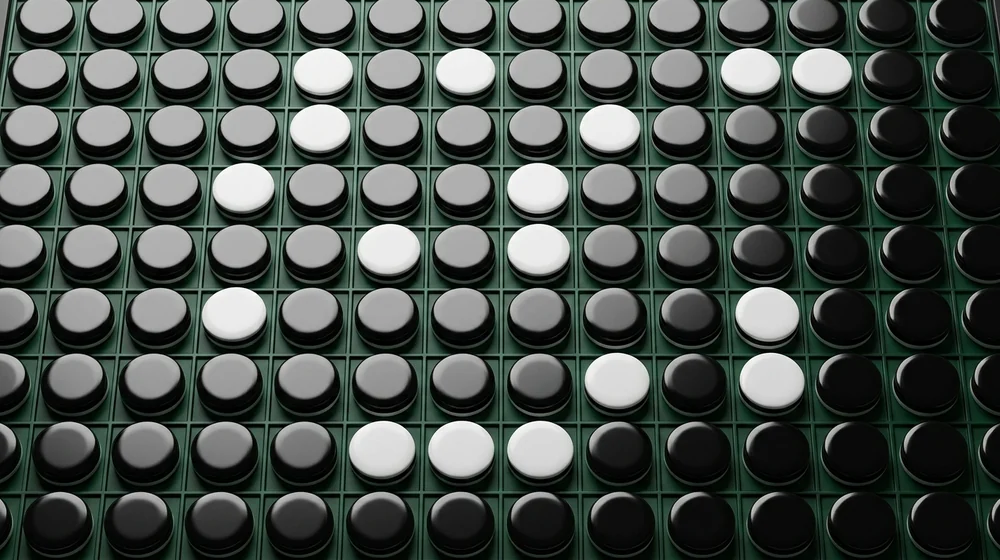
Goal
Finish the game with more discs of your colour than your opponent. When the board fills up (or neither side can move), the majority wins.
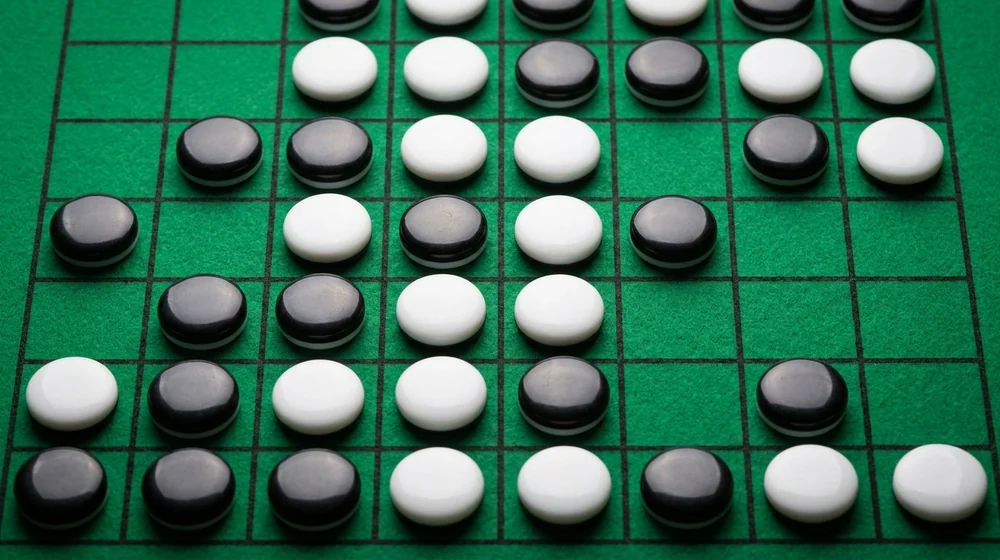
Placing a disc
On your turn, place one disc so that it traps one or more of your opponent's discs in a straight line - horizontally, vertically or diagonally - between the disc you just played and another of your discs.
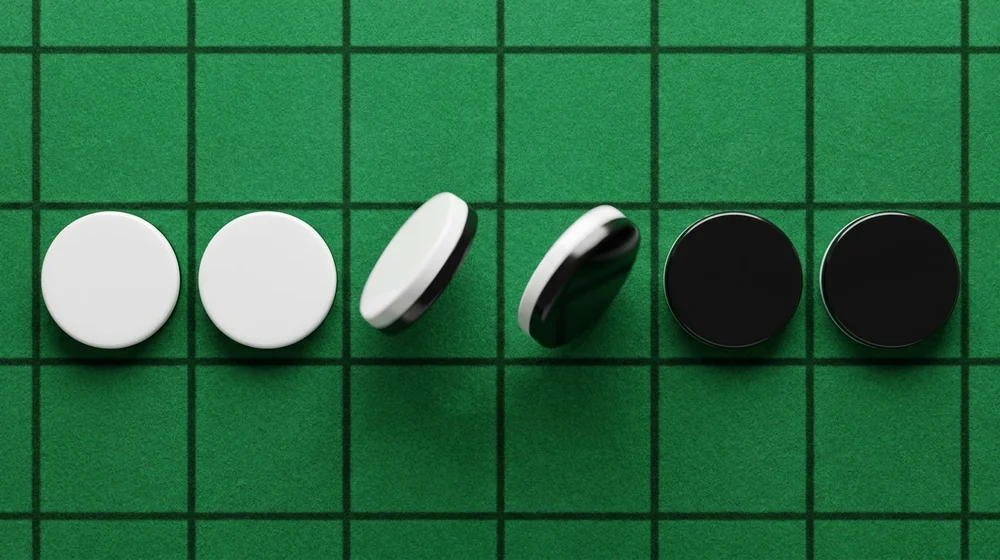
Flipping
Every opponent disc caught in that line flips to your colour. A single move can flip discs in several directions at once.
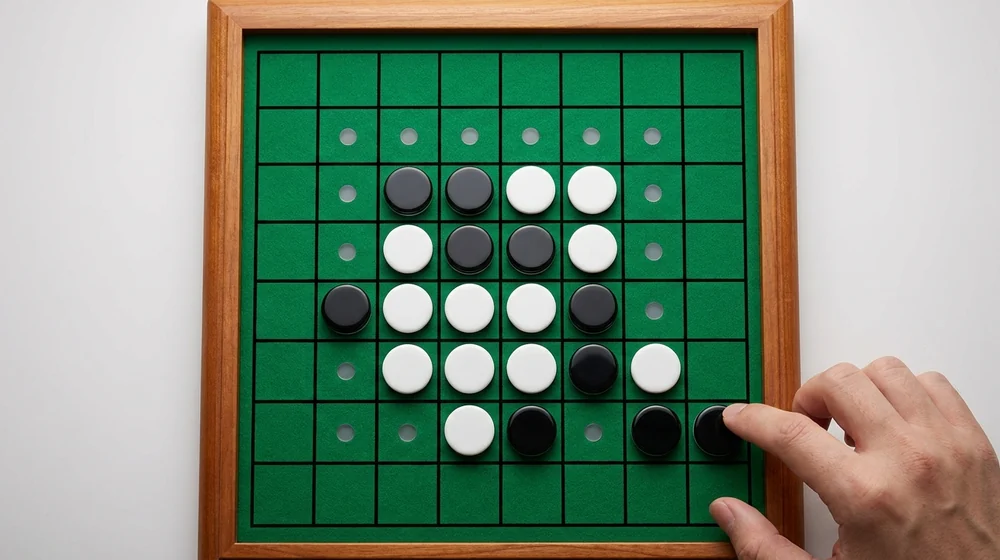
Legal moves only
You may only play where at least one disc flips. Legal squares are highlighted. If you have no legal move, your turn is skipped automatically.
Winning
Play continues until the board is full or both players are stuck. Count the discs - the colour with more discs on the board wins; equal counts are a draw.
History of Reversi
Reversi was popularised in England in the 1880s, when two rival inventors, Lewis Waterman and John Mollett, each claimed to have created it and published competing rule sets. The game was sold by the London firm Jaques and Son and quickly became a Victorian parlour favourite, played on a cross-shaped or square board with double-sided counters.
The game drew on even older "flanking and flipping" pastimes, and for decades it circulated in various forms with slightly different opening rules. Its defining features - the 8x8 board, the two-coloured discs and the flanking capture - stayed remarkably stable across all of them.
In 1971 the Japanese salesman Goro Hasegawa standardised the modern rules, fixed the four-disc diagonal opening, and marketed the game as "Othello". That trademarked version drove a worldwide boom, spawned a World Othello Championship, and became the form most people learn today. "Reversi" now usually refers to the free, un-trademarked classic, while "Othello" refers to Hasegawa's standardised game - two names for what is essentially one brilliant idea.
How to Win Reversi: Strategy
💡 Top tip: Grab a corner whenever you safely can - corner discs can never be flipped and become anchors that let you flip long lines for the rest of the game.
Winning tips, in order of importance
- Play for mobility, not disc count: aim to keep many legal moves open for yourself while starving your opponent of good ones.
- Having the fewest discs in the early middlegame is often winning, because it means your opponent has committed to squares you can flank later.
- Avoid the X-squares (diagonally next to a corner) until a corner is settled - playing one hands your opponent the corner beside it.
- Control the centre early and expand outward slowly; a small, solid group is stronger than a sprawling one you can't defend.
- Force your opponent into the edges and X-squares by leaving them only bad replies - a quiet move that gives you a move and takes one away is gold.
- Count parity in the endgame: try to be the one who plays the last disc into each empty region, since the final move in a pocket usually flips the most.
Advanced tactics for Reversi
- Learn the four X-squares and four C-squares (the cells next to each corner); most losing games can be traced to a single premature move onto one of them.
- Think in terms of stable discs - pieces that can never be flipped again. Build outward from a corner you own, because stability, not raw count, decides the endgame.
- Use quiet moves that reduce your opponent's legal replies. If you can reach a position where they must play into a corner-giving square, the game is often already won.
- Watch edge structure: an unbalanced row of your discs on an edge with a gap can be split and flipped, whereas a solid anchored wall cannot.
- In the endgame, count the empty squares in each isolated region and work out who is forced to move first there - the player who moves last in a region usually gains it.
- Do not automatically take a move that flips many discs; the biggest-flip move is frequently the worst, because it exposes your new discs to a corner-based reply.
- Against a strong opponent, aim to give away discs in the middlegame to keep your mobility high, then convert that freedom into corners and stable edges late.
Common Reversi mistakes to avoid
- Grabbing every disc you can early - a big mid-game lead usually means you are about to be flanked, so play for position, not count.
- Playing an X-square next to an empty corner - it almost always hands your opponent that corner, so leave those diagonals alone until the corner is settled.
- Ignoring your own mobility - if you run out of safe moves you are forced into bad ones, so keep several good replies available at all times.
- Taking the move that flips the most discs - the flashy flip often exposes your new pieces to a corner reply, so quiet moves usually win.
Reversi Variations
Othello
The standardised, trademarked version with a fixed diagonal four-disc opening. Mechanically identical to Reversi but the tournament standard worldwide.
Anti-Reversi (Reversed)
A misere twist: the player with the fewest discs at the end wins, which turns every instinct about flipping and corners upside down.
Reversi 6x6 and 10x10
Smaller and larger boards change the pace completely - 6x6 is a sharp, solved sprint, while 10x10 adds more corners, edges and swing.
Rolit
A four-colour party version for up to four players, using the same flanking capture but with everyone trying to end with the most discs of their own colour.
Free vs fixed opening
Classic Reversi lets players choose where the first four centre discs go; Othello fixes them diagonally. The free opening produces far more starting shapes.
Reversi FAQ
What is the difference between Reversi and Othello?
The rules are essentially identical - place a disc to flank and flip enemy pieces. The main historical difference is the opening: traditional Reversi lets players place the first four discs on the centre squares freely, while Othello fixes those four discs in a set diagonal pattern. Othello is also the trademarked, standardised tournament version.
How many discs are used in Reversi?
A standard game uses 64 discs, one for each square of the 8x8 board. Each disc is dark on one side and light on the other, so any disc can belong to either player and flip between colours during play.
Who goes first in Reversi?
Dark (black) always moves first. On this site you play the dark discs, so you take the opening move of every game against the computer. Moving first is a small but real advantage on the 8x8 board.
What happens if I can't make a move?
If you have no legal move - no square where at least one enemy disc would flip - your turn is skipped and your opponent plays again. If neither player can move, the game ends immediately even if empty squares remain.
Why did my huge lead suddenly disappear?
That is the heart of Reversi. Because a single move can flip a long line of discs, disc counts swing dramatically. A commanding lead built by grabbing lots of discs early often collapses once your opponent takes a corner and flips your loosely held pieces.
Is Reversi a game of luck or skill?
Reversi is pure skill - there is no shuffle, dice or hidden information. Both players see the whole board at all times, so every result comes down to planning, mobility and corner control. Losing means being out-thought, not unlucky.
How do I win at Reversi more often?
Stop chasing discs. Focus on taking corners safely, keeping your own moves plentiful while limiting your opponent's, and avoiding the dangerous squares next to corners. Winning the disc count is the last step, not the first.
What are the corners and edges worth?
Corners are the most valuable squares on the board because a disc in a corner can never be flanked or flipped. Stable edge discs anchored to a corner are next best. The squares directly beside a corner are the most dangerous, since playing them usually lets your opponent seize the corner.
How long does a game of Reversi take?
A full 8x8 game lasts at most 60 moves after the four opening discs, and most games finish in three to six minutes. Games against the beginner computer tend to be quicker; a close match against a strong opponent can run longer as both sides calculate the endgame.
Can a game of Reversi end in a tie?
Yes. If both colours finish with 32 discs each, the game is a draw. Draws are uncommon but perfectly possible, especially between two careful players who both understand corner and parity play.
What is the free opening used here?
In this Reversi version, the first four discs are not fixed. Each player, in turn, places a disc on any of the four empty central squares with no flipping. Only after all four centre squares are filled does normal flanking play begin, which means every game can start from a different shape.
Is Reversi good for your brain?
Reversi is a strong mental workout because it rewards looking several moves ahead, weighing trade-offs and reading the whole board. Like chess or go, it exercises planning and pattern recognition, and it is easy to pick up while being deep enough to study for years.
Reversi guides & strategy
- Reversi vs Othello: what is the difference?
- How to win at Reversi: corners, mobility and parity
- Browse the full Reversi FAQ
Still have a question about Reversi? Browse the full Reversi FAQ, look up a term like flank or mobility in the Reversi glossary, or compare Reversi with the other variants in the rules for every Reversi game.
Last updated .
More Reversi Games
Why Reversi.now?
Reversi.now is built for people who actually play: instant games, a genuine computer opponent at three difficulty levels, unlimited undo, smart hints, and per-game statistics that live in your browser. Every variant is here - Othello, Anti-Reversi, Rolit, and boards from 4x4 to 10x10 - plus something almost no Reversi site has: real online multiplayer, where you and a friend play the same board head-to-head on different devices. Browse the full list of free Reversi games, or read the Reversi FAQ if you're new to the game.
Want to sharpen your game first? Read our guides on how to win at Reversi and why the corners decide almost every game, or discover the surprising history of Reversi and Othello.
Common questions about Reversi.now
Is Reversi.now free?
Yes, completely. Every game, board size and variant on Reversi.now is free to play, with no download, no signup and no payment. You can start a game instantly in your browser.
Do I need to download or install anything?
No. Reversi.now runs entirely in your web browser on any device - desktop, tablet or phone. There is nothing to install and no app store required; just open the page and play.
Is Reversi.now safe to use?
Yes. There is nothing to download, so there is no software to trust, and you can play without creating an account. Signing in with Google is optional and only used to sync your stats across devices.
What makes Reversi.now different from other Reversi sites?
Reversi.now offers seven board variants, a genuine computer opponent at three difficulty levels, a shared daily challenge, global leaderboards, and real-time online multiplayer so you can play head-to-head against a friend - all free and with no download.
Who made Reversi.now?
Reversi.now is an independent site built by a small team of Reversi and Othello enthusiasts who wanted a clean, fast, ad-light place to play the classic disc-flipping game and its variants.
Types of Reversi
"Reversi" isn't a single game so much as a small family built on one brilliant rule: place a disc to flank a line of your opponent's pieces, and flip them all to your colour. From that one idea grow several distinct ways to play. The classic two-player games - Reversi and its standardised cousin Othello - are the heart of the family, played on an 8x8 board where the fight for the corners decides almost everything. A second group varies the board size, from a tiny, fully solved 4x4 puzzle up to a sprawling 10x10 battlefield, changing the pace and depth without touching the rules. A third group twists the rules themselves: Anti-Reversi reverses the goal so the fewest discs wins, while Rolit opens the board to four colours and up to four players. Every version shares the same flank-and-flip heart, so once you know one, you know them all - the differences are in size, opening and goal.
Classic Reversi
The classics are the games most people mean when they say "Reversi" or "Othello" - two players, an 8x8 board, and a duel of pure strategy with no luck at all. The only real difference between them is the opening: classic Reversi lets you place the first four discs freely, while Othello fixes them in a set diagonal cross.
- Reversi - The classic disc-flipping duel - outflank your opponent and rule the board. Reversi is the classic two-player game of flanking and flipping. (Easy to learn, a lifetime to master, 8 × 8 board.)
- Othello - The standardised, tournament version of Reversi - fixed opening, pure skill. Othello is the modern, standardised form of Reversi, the version played at the World Othello Championship every year. (Tournament standard, 8 × 8 board.)
Board Sizes
Same rules, different battlefield. Shrinking the board to 4x4 or 6x6 makes for lightning-fast, fully solvable puzzles, while stretching it to 10x10 opens up longer games with bigger swings and more corners to fight over.
- Mini Reversi (4×4) - Reversi distilled to 16 squares - a two-minute puzzle you can actually solve. Mini Reversi shrinks the board to a 4x4 grid, just sixteen squares, and turns the classic disc-flipping duel into a lightning-fast tactical puzzle. (Tiny but tactical, 4 × 4 board.)
- Reversi 6×6 - A compact 36-square board where every move is a fork in the road. Reversi 6x6 sits right between the tiny 4x4 puzzle and the full 8x8 game. (Fast & sharp, 6 × 6 board.)
- Grand Reversi (10×10) - A hundred squares of flanking warfare - more corners, more edges, bigger swings. Grand Reversi scales the classic up to a 10x10 board of one hundred squares, giving the flank-and-flip duel far more room to breathe. (Long & strategic, 10 × 10 board.)
Rule Twists
These variants keep the flank-and-flip capture but change what you are playing for. Anti-Reversi inverts the goal so the fewest discs wins, turning every instinct upside down, while Rolit adds two more colours and up to four players for a chaotic party version.
- Anti-Reversi - The upside-down Reversi where the fewest discs wins - lose to win. Anti-Reversi, also called Reversed or Misere Reversi, keeps every rule of the classic game but flips the goal: when the board fills up, the player with the fewest discs wins. (Mind-bending, 8 × 8 board.)
- Rolit - Reversi for a crowd - four colours, one board, most discs of your colour wins. Rolit takes the flank-and-flip heart of Reversi and opens it up to as many as four players, each with their own colour of ball. (Party chaos, 8 × 8 board.)
Which Reversi should I play?
Not sure where to start? Match the game to your mood:
New to Reversi
Begin with classic Reversi against the easy computer, or try the compact 6x6 board, where the corners come into play quickly so you learn their value fast.
The tournament game
Play Othello. Its fixed diagonal opening is the standardised, world-championship version of Reversi, with a deep body of theory to explore.
A quick two-minute game
Reach for Mini Reversi on the 4x4 board - a fully solved micro-puzzle you can actually read to the end, over in a couple of minutes.
Something completely different
If you want your instincts scrambled, try Anti-Reversi, where the fewest discs wins, or Rolit, the chaotic four-colour party version.
Play with a friend
Reversi is a two-player game at heart. Jump into online multiplayer and play someone head-to-head on the same board, live.
Ready to dig deeper? Our complete rules hub explains every game above in full - goals, legal moves and strategy - and if you'd rather test your skills against everyone else, take on today's daily challenge, a single shared game that resets at midnight UTC.