Play Grand Reversi (10×10)
A hundred squares of flanking warfare - more corners, more edges, bigger swings.How to Play Grand Reversi (10×10)
In a nutshell: A hundred squares of flanking warfare - more corners, more edges, bigger swings. You play on a 10 × 10 board (100 squares), it's rated long & strategic, and it's a sprawling battle - bigger swings and longer endgames than 8x8.
Grand Reversi scales the classic up to a 10x10 board of one hundred squares, giving the flank-and-flip duel far more room to breathe. The extra rows and columns mean longer edges to fight over, wider open spaces in the middlegame, and disc swings that can be even more dramatic than on the standard board. The four corners are still the anchors of the game, but they are further from the centre, so the struggle to reach them safely unfolds over many more moves. Games last longer and reward patience and long-range planning; a lead can look commanding for a dozen moves and still evaporate once your opponent secures an edge and starts flipping in bulk. If the standard board feels cramped, Grand Reversi is the expansive, slow-burning version where deep strategy has space to unfold.
Grand Reversi at a glance
| Goal | End with more discs than your opponent across the 10x10 board's 100 squares. Big boards mean big final counts and wide margins. |
|---|---|
| Board | 10 × 10 - 100 squares |
| Players | 1 player vs the computer, or 2 players online |
| Difficulty | Long & strategic |
| How it plays | A sprawling battle - bigger swings and longer endgames than 8x8 |
| Computer levels | Easy, Medium, Hard |
| Category | Board Sizes |
Step by step
Goal
End with more discs than your opponent across the 10x10 board's 100 squares. Big boards mean big final counts and wide margins.
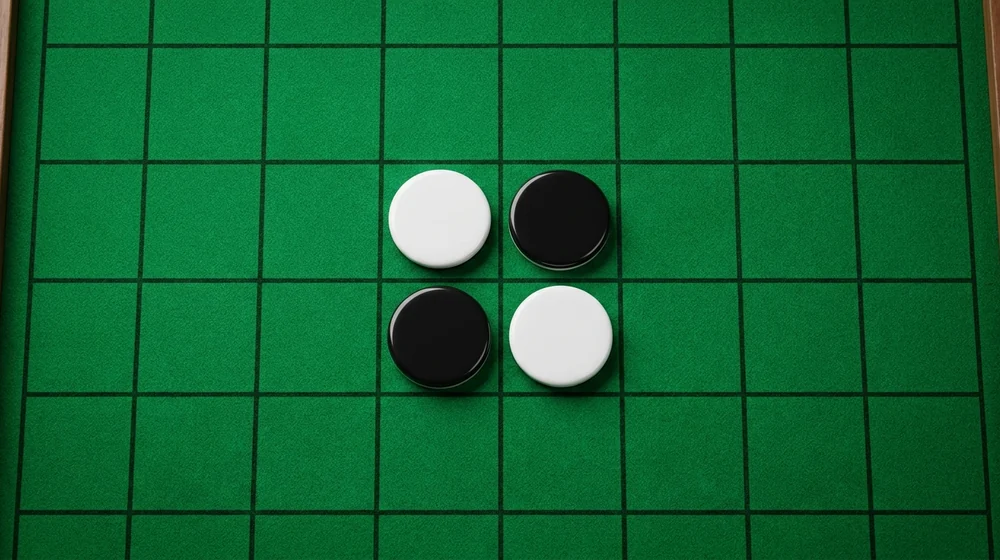
Fixed start
The four central squares begin with two dark and two light discs in the standard diagonal cross. Dark moves first.
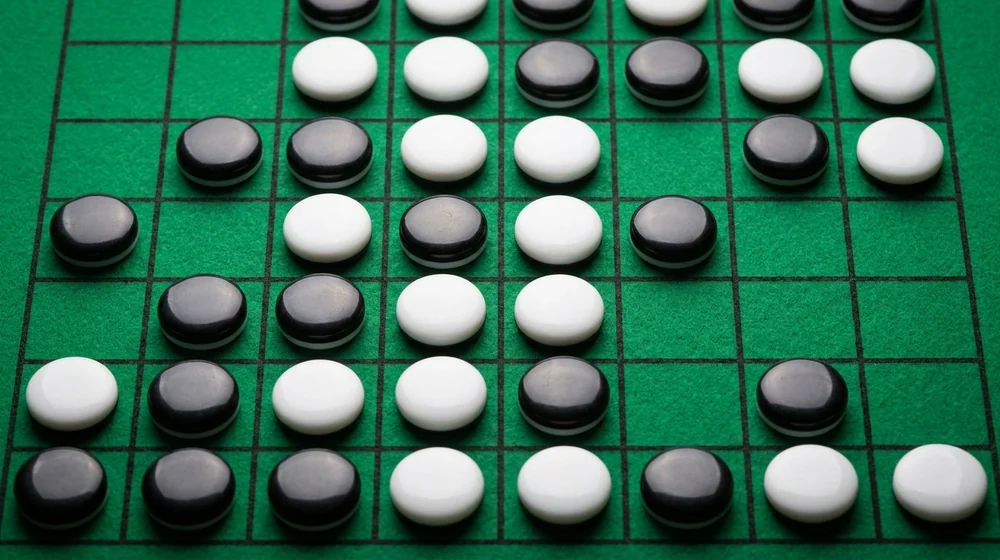
Placing a disc
Flank a straight line of enemy discs between your new disc and another of yours, in any direction. Long edges make for long, sweeping flips.
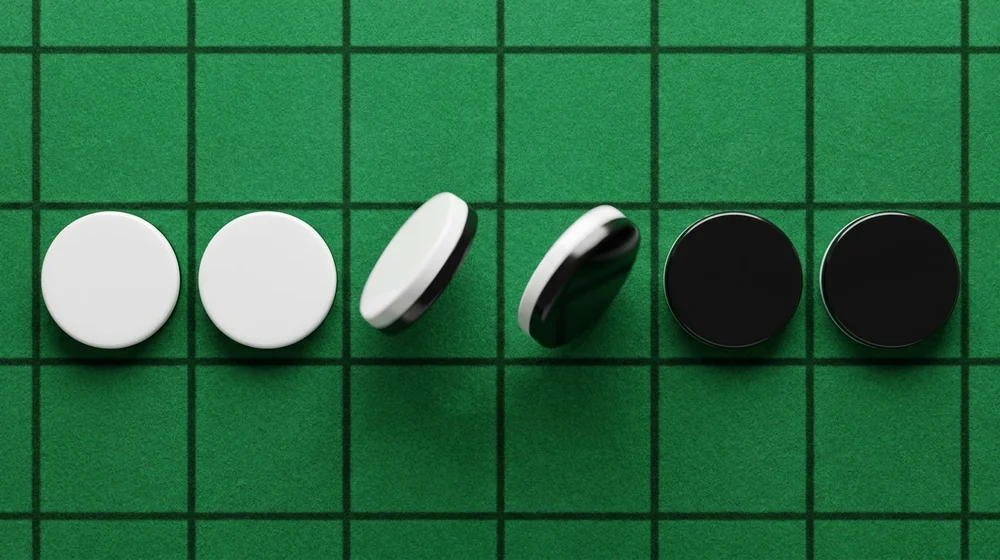
Flipping
Every trapped disc flips. On a 10x10 board a single move down a full edge can flip a huge line at once, so watch those long diagonals and rows.
Winning
Play until the board fills or both sides are stuck, then count. Expect longer games and larger swings than on the standard board.
History of Grand Reversi
Enlarged Reversi boards have appeared throughout the game's history, as players and publishers experimented with sizes beyond the familiar 8x8. Ten-by-ten and other oversized grids offered a way to stretch the game's strategy across more territory without changing its elegant core rule.
Because the standard 8x8 game is already computationally enormous - it was only weakly solved in 2023, after a vast computation, and shown to be a draw - larger boards like 10x10 have remained firmly in the realm of exploratory human play rather than exhaustive analysis. That gives Grand Reversi an open-ended, frontier feel: there is no known perfect strategy to memorise.
Today the big-board version thrives as a variant for players who love the flank-and-flip idea but want longer, more sweeping games, where a single well-timed move down a full edge can rewrite the whole board.
How to Win Grand Reversi: Strategy
💡 Top tip: The corners are further away, so build toward them deliberately over many moves instead of expecting an early scramble.
Winning tips, in order of importance
- Long edges are powerful but dangerous - a solid anchored edge is a fortress, while an unanchored one can be split and flipped in a single sweep.
- Mobility matters even more on a big board; keeping many safe moves open lets you outlast an opponent who overextends into the open centre.
- Beware the long-line flip: on 10x10 a careless move can hand your opponent a full-row or full-diagonal flip that turns the game in one stroke.
- Stay patient in the middlegame - with so many squares, disc count means little until the edges and corners start to settle.
- Guard the X- and C-squares around every corner just as on the standard board; the extra distance does not make them any less lethal.
- Plan the endgame early: with a hundred squares, parity and last-move control over each region are what turn a close board into a clear win.
Advanced tactics for Grand Reversi
- Map your long-term route to each corner from the opening; on a 10x10 board the corner fight is a slow campaign, not a quick skirmish.
- Treat full-length edges as strategic assets - anchor them to corners before committing, because an unanchored long edge is a liability waiting to be flipped.
- Keep your frontier tight in the open middlegame; sprawling into the centre gives your opponent countless flanking targets across the extra space.
- Watch every long diagonal - the biggest single-move swings on 10x10 come from full-diagonal flips that are easy to overlook.
- Delay disc-count evaluation; with a hundred squares, the middlegame count is almost meaningless until the structure sets.
- Break the endgame into regions and count parity in each; on a large board, whoever controls the last move in the big open zones usually wins.
- Use your extra mobility to make repeated quiet, denying moves, forcing your opponent to be the one who first weakens an edge or corner.
Common Grand Reversi mistakes to avoid
- Expecting a quick corner scramble - the corners are far away on 10x10, so build toward them patiently over many moves.
- Extending a long edge without anchoring it - an unanchored full-length edge is a liability that can be flipped in one sweep.
- Overlooking the long diagonals - the biggest single-move swings on the big board come from full-diagonal flips that are easy to miss.
- Judging the game by the middlegame count - with a hundred squares, disc totals mean little until the structure finally settles.
Grand Reversi Variations
Standard 8x8
The classic board where the same strategy applies in a tighter, faster space - the natural step down from Grand Reversi.
Reversi 6x6
A compact, solved board at the opposite end of the size spectrum, ideal for quick sharp games.
Anti Grand Reversi
The reversed win rule on a hundred squares - a marathon of trying to end with as few discs as possible.
Other oversized boards
Reversi has been played on 12x12 and larger grids by enthusiasts chasing ever bigger, longer games.
Rolit
For big-board fans who want company, the four-colour party version brings up to four players into the flanking fray.
Grand Reversi FAQ
How big is the Grand Reversi board?
It is 10x10 - one hundred squares, compared with sixty-four on the standard 8x8 board. That is over fifty percent more space, which lengthens games and widens the possible disc margins.
Are the rules different on 10x10?
No. The flank-and-flip capture, the fixed diagonal opening and the majority-wins goal are all identical. Only the board size changes, which affects pace and strategy rather than the rules.
Is 10x10 Reversi solved?
No. The standard 8x8 game was weakly solved in 2023 (a proven draw with perfect play), but that required an enormous computation, and the far larger 10x10 board is well beyond exhaustive search - so it remains an open, exploratory game.
Why are the swings bigger on a large board?
Longer rows, columns and diagonals mean a single move can flip a much longer line of discs. That makes leads more fragile and comebacks more spectacular than on the standard board.
How long does a Grand Reversi game take?
Longer than the standard game - often five to ten minutes or more - because there are far more squares to fill and more moves before the board settles.
Is Grand Reversi harder than standard Reversi?
It is not harder to learn, since the rules are the same, but it demands more patience and longer-range planning. The extra space rewards players who think many moves ahead and punishes premature commitments.
Grand Reversi guides & strategy
- How to win at Reversi: corners, mobility and parity
- Why corners decide almost every game
- Browse the full Reversi FAQ
Still have a question about Grand Reversi (10×10)? Browse the full Reversi FAQ, look up a term like flank or mobility in the Reversi glossary, or compare Grand Reversi with the other variants in the rules for every Reversi game.
Last updated .