Play Mini Reversi (4×4)
Reversi distilled to 16 squares - a two-minute puzzle you can actually solve.How to Play Mini Reversi (4×4)
In a nutshell: Reversi distilled to 16 squares - a two-minute puzzle you can actually solve. You play on a 4 × 4 board (16 squares), it's rated tiny but tactical, and it's fully solved - the second player wins with perfect play.
Mini Reversi shrinks the board to a 4x4 grid, just sixteen squares, and turns the classic disc-flipping duel into a lightning-fast tactical puzzle. With so little room, every move matters enormously and games are over in a couple of minutes. The tiny board is small enough that mathematicians have completely solved it: with perfect play the second player wins, which makes Mini Reversi a superb place to train your calculation because you can genuinely read a game to its end. It is the ideal warm-up before a full 8x8 game, a gentle introduction for newcomers, and a surprisingly tense contest once you realise how quickly a two-disc lead can flip on a board this cramped.
Mini Reversi at a glance
| Goal | Own more discs than your opponent when the 4x4 board fills up. With sixteen squares, the split is often decided by a single disc. |
|---|---|
| Board | 4 × 4 - 16 squares |
| Players | 1 player vs the computer, or 2 players online |
| Difficulty | Tiny but tactical |
| How it plays | Fully solved - the second player wins with perfect play |
| Computer levels | Easy, Medium, Hard |
| Category | Board Sizes |
Step by step
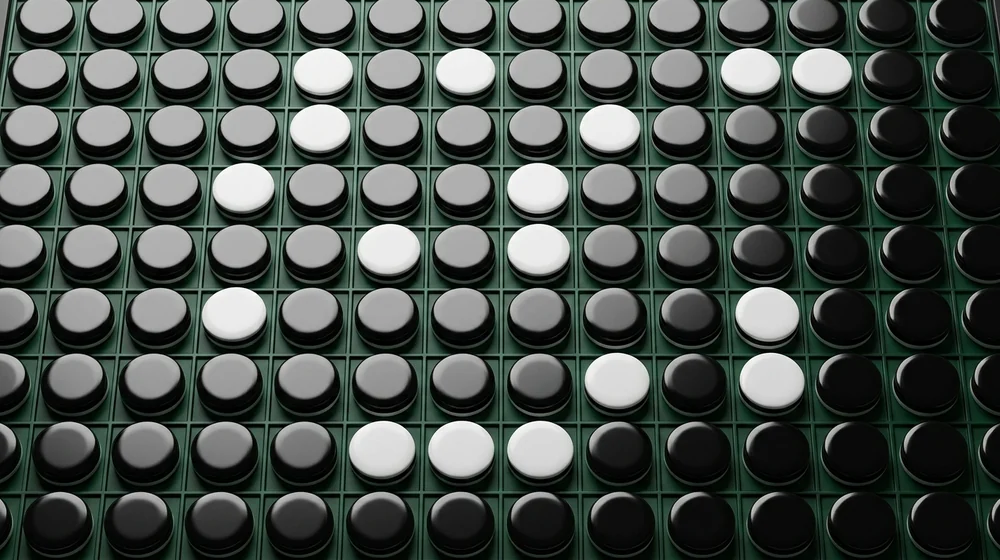
Goal
Own more discs than your opponent when the 4x4 board fills up. With sixteen squares, the split is often decided by a single disc.
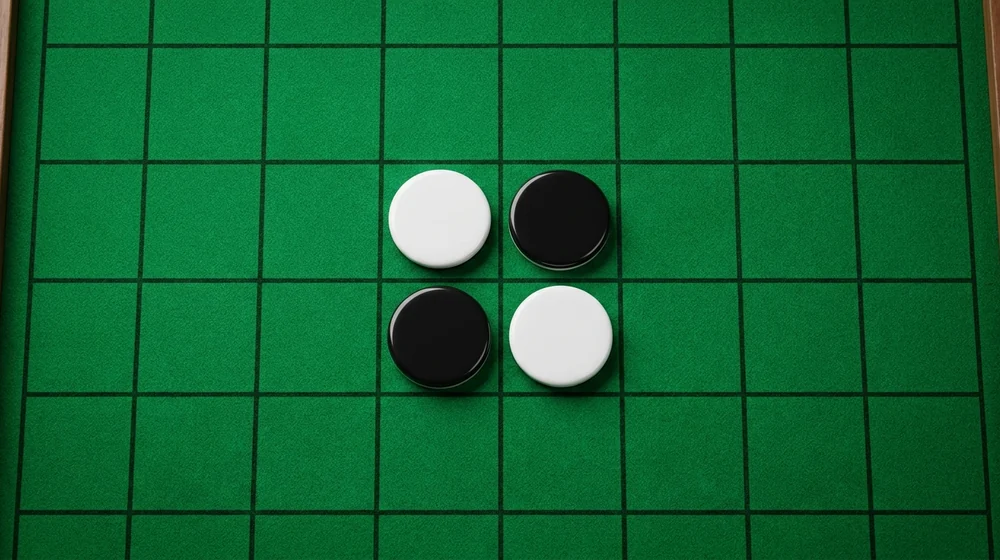
Fixed start
The four central squares begin with two dark and two light discs in the usual diagonal cross - here that is the whole centre of the board.
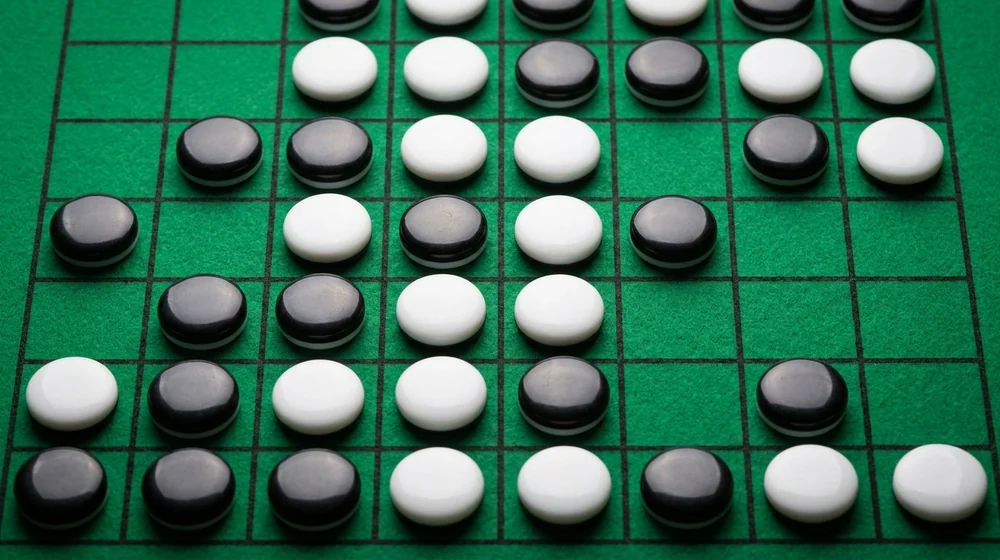
Placing a disc
Play a disc that traps a line of enemy discs between it and another of your discs. On such a small board, most lines are short - one or two discs.
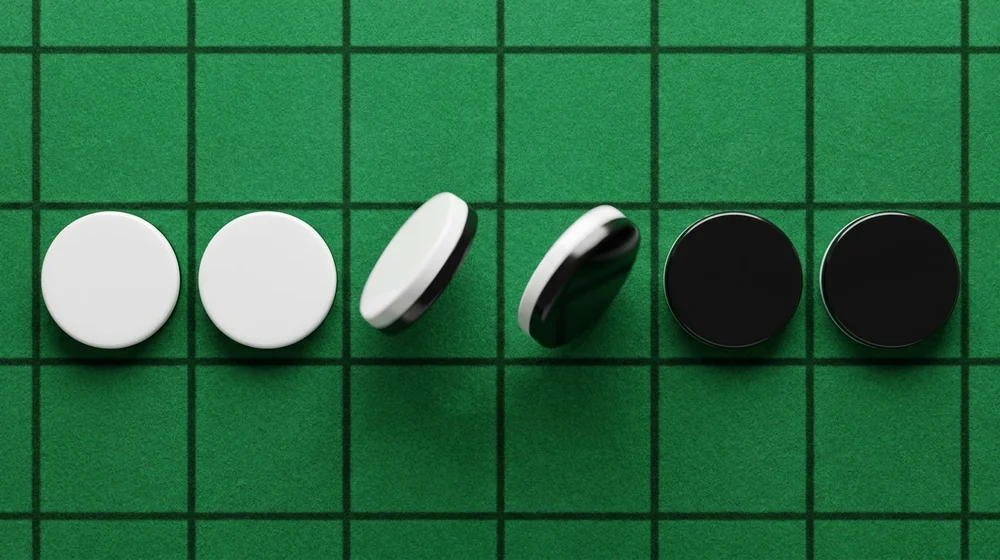
Flipping
Trapped discs flip to your colour. Because the board is tiny, a single flip can shift the balance of the entire game.
Winning
Play until the board is full or nobody can move, then count discs. Skips are common on 4x4, so watch for turns where you are forced to pass.
History of Mini Reversi
Small-board Reversi variants have existed as long as the game itself, used by teachers and players as a quick way to demonstrate the flanking rule without the commitment of a full 8x8 match. The 4x4 board is the smallest on which the game is still interesting rather than trivial.
Because the position space is so small, 4x4 Othello was one of the first sizes to be completely solved by computer search, which established that the second player can always win with correct play. That result made the mini board a favourite teaching tool for game theory and search algorithms.
Today Mini Reversi lives on mostly as a fast, friendly variant and a training board - a place to practise reading games to the end before scaling those skills up to the standard game.
How to Win Mini Reversi: Strategy
💡 Top tip: Corners still win games - on 4x4 a single corner disc can anchor half the board, so fight for them even harder than on the big board.
Winning tips, in order of importance
- Every move can be calculated to the end here; slow down and read the whole line before you play, because there is no room to recover from a blunder.
- Watch for forced passes - on a small board you will often have no legal move, and setting up a position where your opponent must skip is a powerful weapon.
- Don't grab discs greedily; the second player can win with perfect play, so if you move first you must play for tempo and corners, not count.
- Think about which squares your opponent will be forced into, and try to leave them only replies that hand you a corner.
- Because lines are short, flips rarely cascade far - value position and mobility over the size of any single flip.
- Use Mini Reversi to rehearse endgame parity: with so few squares, whoever makes the last move usually takes the game.
Advanced tactics for Mini Reversi
- On 4x4 you can and should calculate the whole game tree from the middlegame on; treat every move as if it were the endgame, because it nearly is.
- Corner control is even more decisive here than on 8x8 - a single corner can lock down a quarter of the board's stable discs.
- Engineer forced passes: a position where your opponent has no move gives you a free tempo that often converts straight into a corner.
- Because flip chains are short, prefer moves that improve your frontier and mobility rather than the move that flips the most discs.
- If you are the first player, play for parity and tempo, not disc count, since a greedy line loses to accurate defence.
- Memorise the handful of key middlegame shapes; on a board this small, recognising one winning pattern is often the whole game.
- Use the solved nature of the board as a checker - after a loss, replay to find the exact move where the winning line slipped away.
Common Mini Reversi mistakes to avoid
- Playing quickly on a board this small - with only sixteen squares you can and should read the whole game to the end before moving.
- Overvaluing disc count - the second player wins with perfect play, so if you move first you must fight for tempo and corners instead.
- Missing forced passes - on 4x4 you often have no legal move, so set up positions that make your opponent skip rather than you.
- Treating a big flip as good - lines are short here, so position and mobility matter far more than the size of any single capture.
Mini Reversi Variations
6x6 Reversi
The next size up, also solved (a second-player win), offering a bit more room to manoeuvre while staying short and sharp.
Standard 8x8
The full game, where the same principles apply but with far more depth, swing and complexity - only weakly solved by computer in 2023.
Anti Mini Reversi
Play 4x4 with the reversed win rule - fewest discs wins - for a brain-bending micro-puzzle.
Two-player hotseat
The tiny board is perfect for passing a device back and forth for quick two-minute duels.
Teaching drills
Coaches use 4x4 to demonstrate flanking, forced passes and endgame parity before moving students to the big board.
Mini Reversi FAQ
Is 4x4 Reversi solved?
Yes. The 4x4 game has been completely analysed and, with perfect play by both sides, the second player wins. That makes it a great board for learning to calculate, since a full game is short enough to read from start to finish.
Why do I have to skip so often on 4x4?
With only sixteen squares, it is common to reach a position where you have no legal move - no square where a disc would flip. When that happens your turn is passed automatically and your opponent plays again.
Is Mini Reversi good for beginners?
Very. The small board makes the flank-and-flip rule easy to see in action, games last only a minute or two, and there is far less to track than on the full 8x8 board, so it is an ideal first taste of Reversi.
How many discs are on a 4x4 board?
Up to sixteen, one per square. The game starts with the four centre discs placed and the remaining twelve are added as play continues, unless the game ends early because neither side can move.
Does the first player lose on 4x4?
With perfect play from both sides, yes - the second player has a winning strategy. In casual play against the computer, though, the first player wins plenty of games, because perfect play is hard to sustain even on a tiny board.
What is a good strategy on such a small board?
Prioritise corners, calculate to the end whenever you can, and use forced passes to your advantage. Disc-grabbing matters even less here than on the big board; position and tempo decide almost everything.
Mini Reversi guides & strategy
- Which Reversi boards are solved?
- How to win at Reversi: the core principles
- Browse the full Reversi FAQ
Still have a question about Mini Reversi (4×4)? Browse the full Reversi FAQ, look up a term like flank or mobility in the Reversi glossary, or compare Mini Reversi with the other variants in the rules for every Reversi game.
Last updated .