How to Play Reversi 6×6
In a nutshell: A compact 36-square board where every move is a fork in the road. You play on a 6 × 6 board (36 squares), it's rated fast & sharp, and it's solved - the second player wins 20-16 with perfect play.
Reversi 6x6 sits right between the tiny 4x4 puzzle and the full 8x8 game. Its thirty-six squares give you real room to plan - corners, edges and mobility all matter - while keeping games short enough to finish in a few minutes. Like the 4x4 board, 6x6 Othello has been completely solved: with flawless play the second player wins by the narrow margin of 20 discs to 16. That makes it a fascinating middle ground for study, because good play is genuinely rewarded but the whole game is still shallow enough to calculate deeply. For casual players it is simply a brisk, punchy version of Reversi where a single misstep near a corner can swing the whole board, and where the compact size keeps the tension high from the very first disc.
Reversi 6×6 at a glance
| Goal | Finish with more discs than your opponent on the 6x6 board's 36 squares. Perfect play splits it 20-16, so most games are close. |
|---|---|
| Board | 6 × 6 - 36 squares |
| Players | 1 player vs the computer, or 2 players online |
| Difficulty | Fast & sharp |
| How it plays | Solved - the second player wins 20-16 with perfect play |
| Computer levels | Easy, Medium, Hard |
| Category | Board Sizes |
Step by step
Goal
Finish with more discs than your opponent on the 6x6 board's 36 squares. Perfect play splits it 20-16, so most games are close.
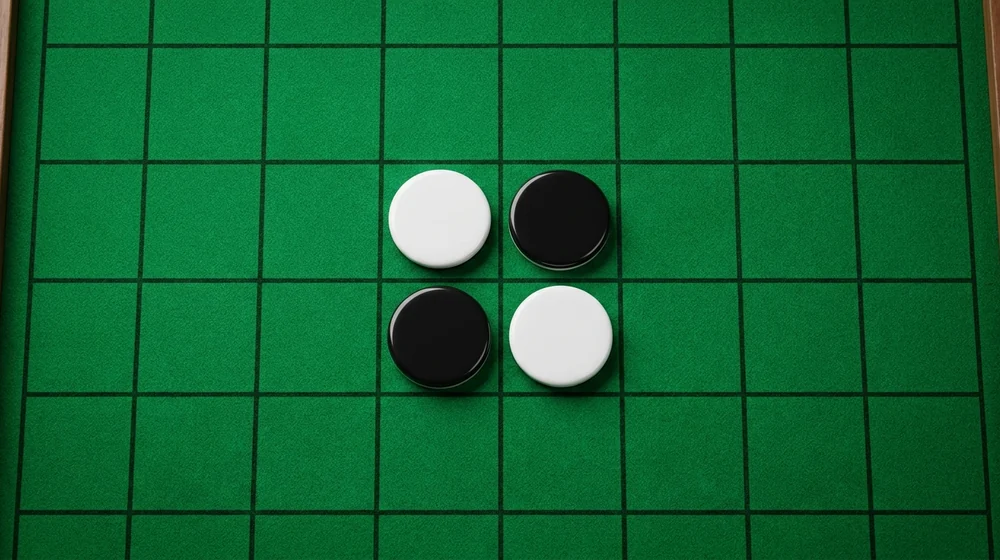
Fixed start
The four central squares begin with the usual diagonal cross of two dark and two light discs. Dark moves first.
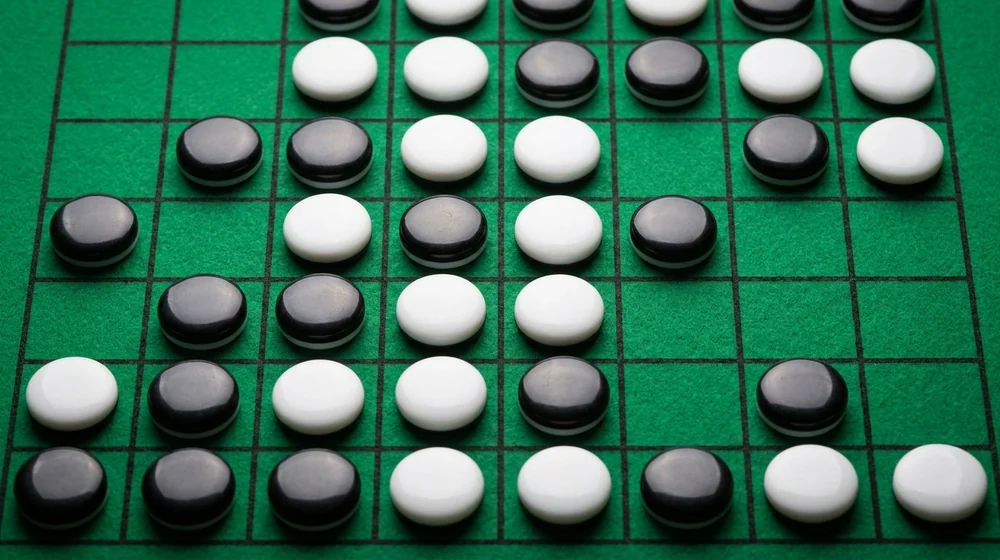
Placing a disc
Play where you flank a straight line of enemy discs between your new disc and one you already own, in any of the eight directions.
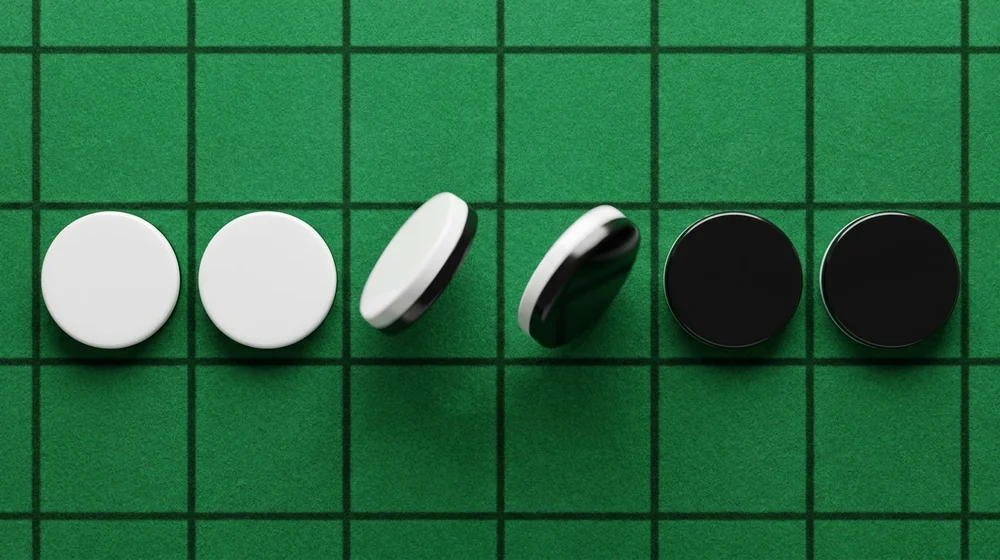
Flipping
All trapped enemy discs flip. On 6x6 the four corners are only a couple of moves from the centre, so corner fights start early.
Winning
Continue until the board fills or both sides are stuck, then count discs. Expect tight margins - a two-disc win is a solid result here.
History of Reversi 6×6
Reversi has always been played on boards of different sizes, and the 6x6 grid became a natural object of study once computers were powerful enough to analyse it exhaustively. Sitting between the trivially small 4x4 board and the vastly larger 8x8 game (which would not be solved until 2023, decades later), it offered researchers a size that was both solvable and strategically rich, and it was solved by J. Feinstein back in 1993.
The complete solution - a 20-16 win for the second player with perfect play - is one of the well-known results in combinatorial game analysis, often cited alongside the solutions for the 4x4 board. It confirmed that even on a compact grid, Reversi's balance tips slightly toward the player who responds rather than the one who leads.
For everyday players, 6x6 endures as a brisk alternative to the full game: long enough to feel like real Reversi, short enough to play several rounds in the time a single 8x8 game would take.
How to Win Reversi 6×6: Strategy
💡 Top tip: Corners come into play fast on 6x6, so plan your route to them from the opening rather than drifting toward them late.
Winning tips, in order of importance
- Keep your position compact and central at first; the smaller board punishes overextension even faster than the standard game.
- Guard the X-squares religiously - with corners so close, a careless diagonal move gives one away almost immediately.
- Mobility still beats material: aim to keep several safe moves available while forcing your opponent toward the edges.
- Because the board is solved as a narrow second-player win, moving second means you can play for the long game; moving first means pressing for tempo and corners.
- Count parity earlier than you would on 8x8 - with only 36 squares, the endgame arrives quickly and last-move control is decisive.
- Don't be seduced by a big mid-game flip; on a compact board the exposed discs it leaves behind are easy for your opponent to flank back.
Advanced tactics for Reversi 6×6
- Plan corner approaches from the first few moves; the short distance to the corners means the fight for them is effectively part of the opening.
- Treat X-squares as almost untouchable until the neighbouring corner is settled - the penalty for a loose diagonal move is immediate on 6x6.
- Prioritise stable discs anchored to corners over raw count, exactly as on 8x8, but expect the stable structure to form earlier.
- Because the endgame comes fast, start counting empty-square parity well before the board is close to full.
- Use quiet, move-denying plays to force your opponent onto the edges, where their replies tend to open corners for you.
- If you are the second player, lean on the solved advantage: keep the position balanced and let your opponent commit to weakening moves.
- Avoid large speculative flips; on a small board the frontier they create is quickly exploited by an alert opponent.
Common Reversi 6×6 mistakes to avoid
- Drifting toward the corners instead of planning for them - on 6x6 the corner fight starts almost immediately, so aim for them from move one.
- Overextending into the centre early - the compact board punishes a sprawling position even faster than the standard game.
- Playing a diagonal square next to an empty corner - with corners so close, a careless X-square move gives one away at once.
- Counting parity too late - the endgame arrives fast on 36 squares, so track who makes the last move well before the board fills.
Reversi 6×6 Variations
Mini Reversi (4x4)
An even smaller solved board where full games can be read start to finish - a great warm-up for 6x6.
Standard 8x8
The classic board, far deeper and richer, where 6x6 skills transfer directly but with more room and swing.
Grand Reversi (10x10)
A larger board with more corners and edges for players who want longer, more sprawling games.
Anti 6x6
The reversed win condition on the compact board makes for a tight, counter-intuitive puzzle.
Quick-match play
6x6's speed makes it ideal for best-of-several matches, where consistency across short games decides the winner.
Reversi 6×6 FAQ
Is 6x6 Reversi solved?
Yes. With perfect play by both sides, the second player wins 20-16. The board is small enough for computers to search completely, but large enough that the play is genuinely strategic.
How is 6x6 different from the standard game?
The 6x6 board has four fewer rows and columns than 8x8, so corners are closer to the centre and the game is faster and sharper. The rules are identical; only the size and pace change.
How many discs fit on a 6x6 board?
Thirty-six, one per square. Games often fill the board, ending in a count near the solved 20-16 split, though margins vary in casual play.
Is 6x6 easier than 8x8?
It is quicker and easier to calculate, but not necessarily easier to win - the compact board leaves little room to recover from a mistake, so precise play matters a lot.
Who has the advantage on 6x6?
With perfect play the second player wins, so moving second is a theoretical advantage. In practice, against the computer, both sides win plenty depending on how accurately they play.
Why do corners matter so much here?
As on any Reversi board, corner discs can never be flipped, so they are permanent anchors. On the small 6x6 grid a single corner controls a larger share of the board, making corners even more valuable relative to their number.
Reversi 6×6 guides & strategy
Still have a question about Reversi 6×6? Browse the full Reversi FAQ, look up a term like flank or mobility in the Reversi glossary, or compare Reversi 6×6 with the other variants in the rules for every Reversi game.
Last updated .