Play Othello
The standardised, tournament version of Reversi - fixed opening, pure skill.How to Play Othello
In a nutshell: The standardised, tournament version of Reversi - fixed opening, pure skill. You play on an 8 × 8 board (64 squares), it's rated tournament standard, and it's a razor-thin margin at the top level - single discs decide titles.
Othello is the modern, standardised form of Reversi, the version played at the World Othello Championship every year. The rules are the same flank-and-flip capture, but Othello fixes the opening: the four central squares always start with two dark and two light discs in a diagonal cross, so every game begins from the identical, balanced position. That single change turns Othello into a game of deep, studied theory - openings have names, edge shapes are catalogued, and the strongest computer programs play far above any human. Underneath the theory, the appeal is the same wild swing that makes Reversi famous: the disc count can reverse in a single move, and the player quietly steering toward the corners usually wins, no matter how far behind they look.
Othello at a glance
| Goal | End the game with more discs of your colour than your opponent. The board holds 64 discs; whoever owns more when play stops wins. |
|---|---|
| Board | 8 × 8 - 64 squares |
| Players | 1 player vs the computer, or 2 players online |
| Difficulty | Tournament standard |
| How it plays | A razor-thin margin at the top level - single discs decide titles |
| Computer levels | Easy, Medium, Hard |
| Category | Classic Reversi |
Step by step
Goal
End the game with more discs of your colour than your opponent. The board holds 64 discs; whoever owns more when play stops wins.
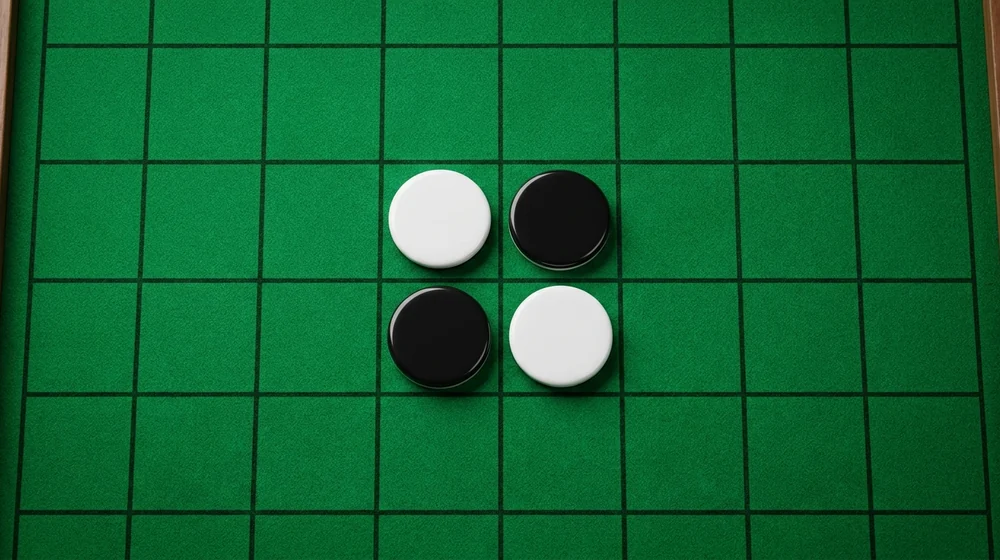
Fixed start
The four centre squares begin filled: dark on e4 and d5, light on d4 and e5 (a diagonal cross). Dark always moves first.
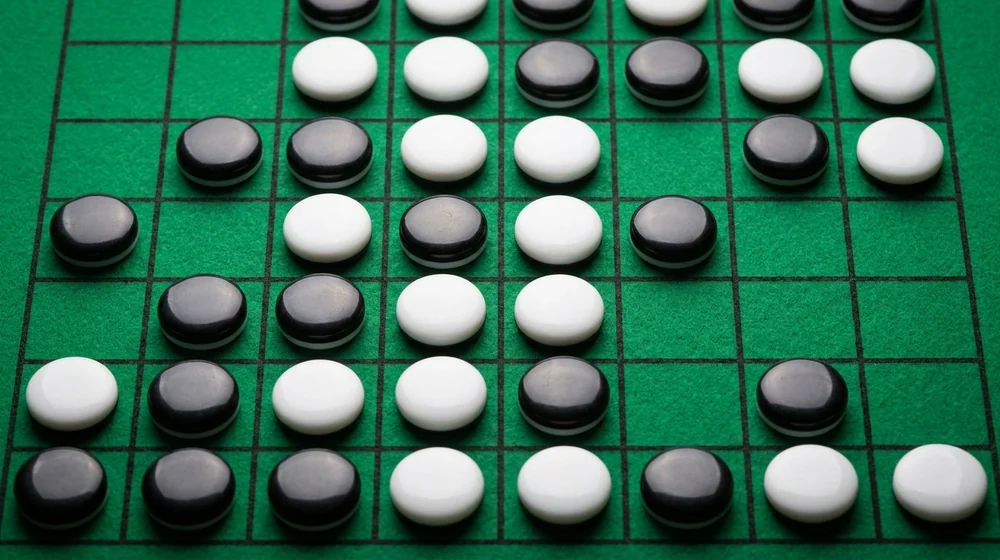
Placing a disc
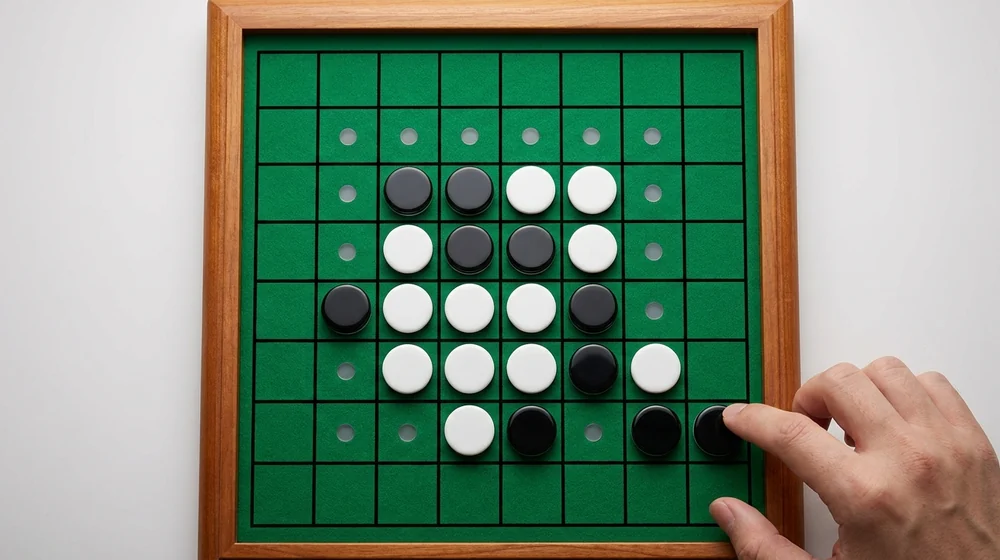
Play a disc so it traps a straight line of enemy discs - in any of the eight directions - between your new disc and another of your discs already on the board.
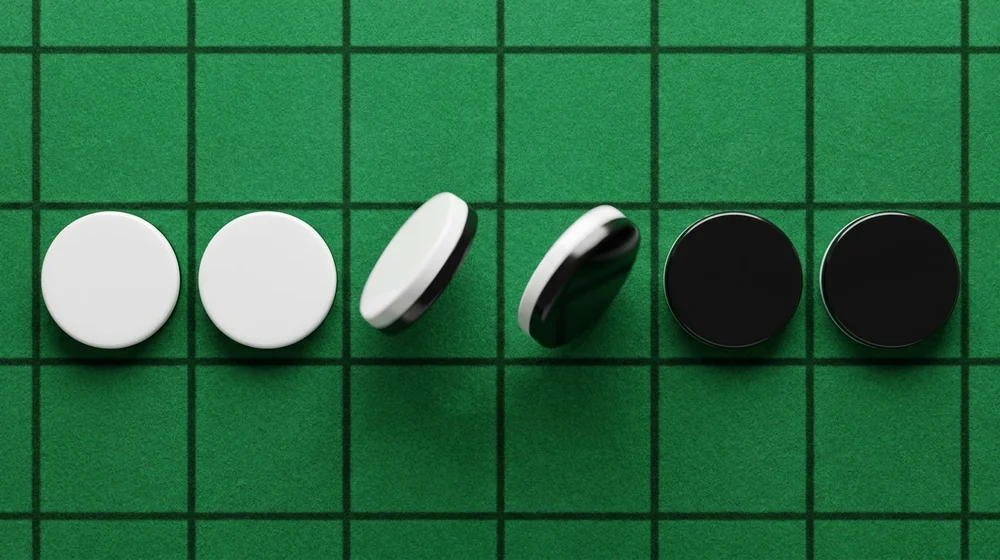
Flipping
All trapped enemy discs in every direction of that move flip to your colour at once. You must flip at least one disc for a move to be legal.
Skips and finish
If you have no legal move you pass automatically. The game ends when the board is full or neither side can move; count discs to find the winner.
History of Othello
Othello was created in its modern form by Goro Hasegawa in Japan and released commercially in 1973. Hasegawa took the Victorian game of Reversi, fixed its opening into a set diagonal cross, standardised the rules, and gave it a memorable name - inspired, he said, by Shakespeare's play about a Moor, echoing the black-and-white discs.
The game was an immediate sensation in Japan and spread rapidly around the world through the 1970s and 1980s. The first World Othello Championship was held in 1977, cementing the fixed-opening version as the competitive standard and giving rise to a body of opening theory, edge analysis and endgame technique.
Othello also became a landmark in artificial intelligence. In 1997 the program Logistello defeated the reigning world champion Takeshi Murakami six games to nil, and modern engines now play far beyond human strength. In 2023 the 8x8 game was weakly solved and proven to be a draw with perfect play, yet Othello endures as one of the most elegant abstract strategy games ever standardised - unbeatably deep for humans even when the theoretical result is known.
How to Win Othello: Strategy
💡 Top tip: Corners are everything - an Othello disc in a corner is permanently stable, so most sound plans revolve around safely capturing corners and denying them to your opponent.
Winning tips, in order of importance
- Prize mobility over material: keep your legal-move count high and squeeze your opponent's down until they are forced into a corner-giving square.
- Stay small and central in the opening; a compact position gives your opponent fewer discs to flank and keeps your options open.
- Never play an X-square (diagonally adjacent to a corner) unless the corner is already yours or dead - it is the most common way strong players lose.
- Build stable edges only when they are anchored; an unanchored edge line can be undermined and flipped wholesale.
- Think about disc parity in the final dozen moves - arranging to make the last move in each empty pocket often swings the count decisively.
- Resist grabbing a big pile of discs mid-game; the flashy move usually loosens your position and hands the initiative back.
Advanced tactics for Othello
- Memorise the danger squares around each corner - the X-square and the two C-squares - and treat any move onto them as a last resort until that corner is resolved.
- Evaluate positions by stable-disc count, not total discs: a piece is only truly yours once it can never be flipped, which starts from corners and grows along anchored edges.
- Aim to reach positions where your opponent has only bad moves. A single well-timed quiet move that removes their options is worth more than any flip.
- Learn common edge configurations; knowing which edge shapes are safe and which can be split lets you take edges without exposing a corner.
- Track parity late: count the empty squares in each region and manoeuvre so you make the final move where it flips the most.
- Sacrifice discs on purpose in the middlegame to preserve mobility, then cash that freedom into corners in the last fifteen moves.
- When two moves both look fine, prefer the one that keeps your position compact and your opponent's frontier discs exposed to future flanks.
Common Othello mistakes to avoid
- Building loosely along an edge without an anchor - an unanchored edge can be split and flipped wholesale, so only extend edges you can hold.
- Chasing disc count in the middlegame - top players hold few discs on purpose to keep mobility and flip a majority near the end.
- Moving onto a C-square or X-square before the corner is resolved - it is the single most common way a promising Othello game is lost.
- Forgetting endgame parity - failing to count who makes the last move in each region gives away the tight margins that decide Othello.
Othello Variations
Reversi (free opening)
The older classic that lets players choose where the first four centre discs go, producing far more varied starting shapes than Othello's fixed cross.
Anti-Othello
The misere version where the player with the fewest discs at the end wins - the same board, every instinct inverted.
Different board sizes
6x6 and 10x10 Othello change the theory entirely; 6x6 is a solved second-player win, while 10x10 adds extra corners and edges.
Rolit
A four-player, four-colour cousin using the same capture rule, designed as a lively party game rather than a two-player duel.
Blitz and correspondence
Othello is played at fast time controls in club blitz and at slow, deeply calculated speeds by correspondence and email, each rewarding different skills.
Othello FAQ
Is Othello the same as Reversi?
The playing rules are the same flank-and-flip capture on an 8x8 board. Othello is the trademarked, standardised version created in 1973 with a fixed diagonal opening and official tournament rules, whereas Reversi is the older, free-form classic that allows a choice of opening discs.
What is the standard Othello opening position?
The four central squares start filled: light discs on d4 and e5, dark discs on e4 and d5, forming a diagonal cross. This position is identical in every game, which is what makes Othello opening theory possible.
Who moves first in Othello?
Dark (black) always moves first. On this site you play dark against the computer, giving you the opening move each game. First move is considered a slight edge on the 8x8 board.
Why is disc count misleading in the middlegame?
Because a single move can flip a long chain, the leader in discs at move 30 is often losing. Strong players deliberately hold few discs mid-game to keep their mobility and flip a decisive majority near the end.
How strong are Othello computer programs?
Extremely strong - top engines play close to perfectly and have not been beaten by a human in serious play for many years. In 2023 the 8x8 game was weakly solved by Hiroki Takizawa and proven to be a draw with perfect play, and the best programs are far beyond human level, which is why the hard computer here is a real challenge.
What is an X-square and why is it dangerous?
An X-square is a cell diagonally next to a corner. Playing one before the corner is settled usually gives your opponent a safe way to take that corner, so avoiding premature X-square moves is one of the first rules good players learn.
Can Othello end in a draw?
Yes. If both sides finish with 32 discs, the game is drawn. It is uncommon but legitimate, and at the highest level games are often decided by a margin of just two discs.
Is there a first-player advantage in Othello?
Dark has a very small edge from moving first, but the game is close to balanced. In 2023 the 8x8 game was weakly solved and shown to be a draw with perfect play by both sides, so neither colour can force a win. In practice, skill differences matter far more than who moves first.
How do I get better at Othello?
Study corner and edge play, learn to value mobility over disc count, and practise counting parity in the endgame. Reviewing your losses to see which move gave up a corner is the fastest way to improve.
What is the World Othello Championship?
It is the annual international tournament, held since 1977, where the world's best players compete under the standardised Othello rules. Its existence is a big reason the fixed-opening Othello form became the dominant way to play worldwide.
Othello guides & strategy
- What is Othello and how is it played?
- Why corners decide almost every game
- Browse the full Reversi FAQ
Still have a question about Othello? Browse the full Reversi FAQ, look up a term like flank or mobility in the Reversi glossary, or compare Othello with the other variants in the rules for every Reversi game.
Last updated .